What is a Partial Knee Replacement?
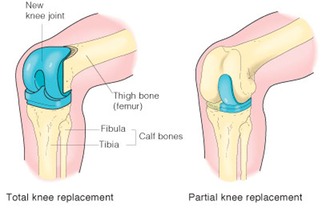
A partial knee replacement (PKR) is an operation to replace one side of the damaged knee joint. The inside half of the knee (medial side) is much more commonly affected and thus replaced. The damaged joint surface is removed and the underlying bone shaped. A metal and plastic replacement is then fixed in place, usually with cement.
Who Benefits from a Partial Knee Replacement?
A PKR is useful for patients with damage limited to the inner half of the knee joint. This is commonly the case with knees damaged secondary to trauma to the cartilage disc's (menisci). PKR is used to relieve pain where non-operative treatment has failed.
PKR is usually recommeded for those over 50 years of age with a mobile knee.
A PKR is often used in patients with limited knee arthritis to delay the need for a full knee replacement. A PKR offers a faster recovery than a total knee replacement and usually results in a better range of motion.
A stiff knee or one with widespread damage is not a candidate for a PKR.
What is Involved for the Patient?
- Usually four to five nights in hospital
- A spinal or general anaesthetic (either way you wont hear or see anything)
- The operation takes about 80 minutes
- One long incision down the middle of the knee
- Full weight bearing after surgery
- Crutches for two to six weeks
- Driving four weeks after surgery
What is the Recovery Period?
Recovery from the operation is the time it takes for the knee to regain strength and motion. One advantage of PKR over total knee replacement is a more rapid recovery.
Generally patients are ready for light work six weeks after a PKR and heavy work at the four month mark. It can take 12 months to realise the full benefits of surgery.
What is the Success Rate of a Partial Knee Replacement?
Approximately 9 out of 10 patients who have a PKR are satisfied.
- 85% return to work and or sport
- When a PKR fails with time it is usually converted to a total knee replacement
- About 90% of PKRs are still functioning at 5 years
- About 90% of PKRs are still functioning at 10 years
- Because only part of the knee has been replaced patients can still have symptoms from unreplaced areas.
What are the Risks of a Partial Knee Replacement?
All operations carry some risk. Partial knee replacement is a safe operation but occasionally complications occur.
Risks common to all operations include:
- Infection
- Blood clots in the legs
- Bleeding
- Damage to surrounding nerves and blood vessels
Risks particular to a PKR include:
- Knee stiffness
- Over time, failure of the rest of the knee
- Component loosening
- Incomplete symptom relief
- Pain syndromes
Why Have Julian Perform Your Partial Knee Replacement
Julian is very experienced in computer assisted knee surgery. He now utilises this technology to assist in accurately preparing the bone cuts for the partial replacement. Accurate bone cuts should improve the component position. This should lead to improved function and potential longevity of the replacement.
I Think I May Benefit From a Partial Knee Replacement
If you think you may benefit from a partial knee replacement please arrange a consultation with Julian Stoddart. You will receive a comprehensive assessment of your knee to determine if this operation is right for you.
Click here to find out how to arrange an appointment.